


Unlock the Power of Precision Cooking
Say goodbye to uneven heating and half-frozen centers. Inverter microwaves deliver steady, controlled heat for faster, tastier, and perfectly cooked meals—every time.
Shop Inverter Microwaves
What are Inverter Microwaves?
Do you find yourself annoyed by hot or cold spots when reheating food? Do you overcook meals in the microwave, even when using the same settings as last time?
If you answered ‘yes’ to either of these, then your solution may be upgrading to an inverter microwave. Inverter microwaves are designed to provide more precise and consistent heating than standard microwaves, allowing you to heat or defrost food faster, more reliably, and using less energy.
Although inverter microwave technology has been around for decades, these appliances are still considered a relatively modern innovation in New Zealand. Many Kiwis continue to rely on conventional microwave ovens instead of the newer inverter models.
And while the technology itself isn’t new, the innovations powering the latest generation of inverter microwaves is more advanced, more reliably tested, and more affordable than ever before. So keep reading to find out what exactly an inverter microwave is and why you should be using one.
What is an inverter microwave?
An inverter microwave is a type of microwave oven that uses inverter technology to deliver heat power in a constant stream, making it heat food more evenly and consistently than a traditional microwave.
Inverter technology was first introduced in 1988 by Panasonic and has since been adopted by most major microwave manufacturers. Today, you can purchase inverter microwaves from many top brands, including Sharp, LG, Samsung, and more.
What are the benefits of an inverter microwave?
Inverter microwaves have grown in popularity over the last few decades — and the reasons are clear to see. When you compare inverter microwaves to standard microwaves, it’s clear that this technology offers a superior cooking experience on a number of levels, without any obvious drawbacks. So let’s consider a few of the situations where an inverter microwave can be an advantage!
Cooking Delicate Foods
Heating certain foods in the microwave can be a delicate operation. The inconsistent heating of conventional microwaves often leads to the destruction of food cells, which can impact both texture and flavour.
Foods like eggs, fish and poultry, butter and cheese, as well as chocolate, can all be difficult to heat properly in a microwave. This is because these foods are at a high risk of drying out, burning, or becoming rubbery when overcooked, due to excessive heat. Inverter microwaves can be a great solution if you often find yourself preparing any of these.
Heating Without Splatter
If you are melting foods like butter or chocolate for use in baking, or simply reheating soups or stews, you may find yourself often having to clean up a mess in your microwave. The reason for this mess is that when your conventional microwave operates at a lower power setting, it has to cycle itself on and off to avoid overheating your food (more on this below).
Unlike conventional microwaves, inverter microwaves do not have to cycle themselves on and off. They are able to operate at continuous yet reduced power level, which is ideal for melting or reheating certain types of food and reducing splatter. Want to stop cleaning up the inside of your microwave? We recommend an inverter model!
Better Defrosting
Conventional microwaves often struggled with defrosting food, particularly frozen meats. When defrosted in the microwave, you may find food is under-defrosted in the centre or has dry, already-cooked edges, which is no good!
A key innovation in inverter microwave technology is defrosting. Inverter microwaves are able to defrost more quickly and more evenly than previous models. This means your food will be more likely to retain a better colour, shape, and texture after it’s been defrosted by an inverter microwave.
Want to learn more about some of the best microwaves in New Zealand? Check out our blog on the subject here.
What’s the difference between an inverter microwave and a conventional microwave?
Now that we’ve gone over the benefits of an inverter microwave, let’s talk about how an inverter model is different from a conventional one. The key difference between an inverter microwave and a conventional microwave is how your home’s electricity is converted into heat by the appliance.
For example, did you know that traditional microwaves only have one true power setting? As we mentioned above, non-inverter microwaves have to mimic lower power settings by rapidly switching themselves on and off, as a way to deliver less heat to the food you are preparing.
Source: https://www.panasonic.com/nz/consumer/household-learn/technology/what_s-an-inverter.html
This is why it’s common to find hot and cold spots in a dish after you’ve warmed it in the microwave (unless you were smart enough to stir it afterwards). It’s also why conventional microwaves use a turntable to rotate your food as it’s cooking.
Traditional microwaves often overcook food or leave it partially frozen after defrosting, due to their uneven heating, which can be a real pain. When you’re cooking something that requires a specific temperature threshold, such as poaching eggs or melting butter, you may run into problems.
By contrast, inverter microwaves are able to deliver consistent heat at the level you’ve specified. So long as you’ve got your temperature settings right, you won’t have to deal with food that’s accidentally overcooked or left half-frozen. And you won’t have to deal with hot spots and cold spots anymore!
So how does an inverter microwave work exactly?
Let’s dive into the technical details for a second.
Conventional microwave ovens use a device called a magnetron to convert electricity into microwave radiation. The microwaves generated by this magnetron are then directed at the food you’ve placed inside your appliance. The waves shake the water molecules inside the food and produce heat as a byproduct of their interaction. This is what warms your meal!
The only problem is that the magnetrons in most microwaves are only capable of operating at full power — either on or off. And that’s where inverter technology enters the picture.
Inverter-type microwaves are able to vary their magnetron’s power level, modulating it to operate at a range below its typical output. This allows an inverter microwave to truly cook on medium or low power — instead of simply switching itself on and off.
In inverter microwaves, the transformer that delivers AC electricity to the magnetron is replaced by an inverter as part of a variable power circuit. This circuit is able to convert your home’s DC electricity into AC electricity of a specific voltage, allowing you to control the specific frequency of microwaves your appliance is generating. Science is great, isn’t it?
What’s the difference between an inverter microwave and convection microwave?
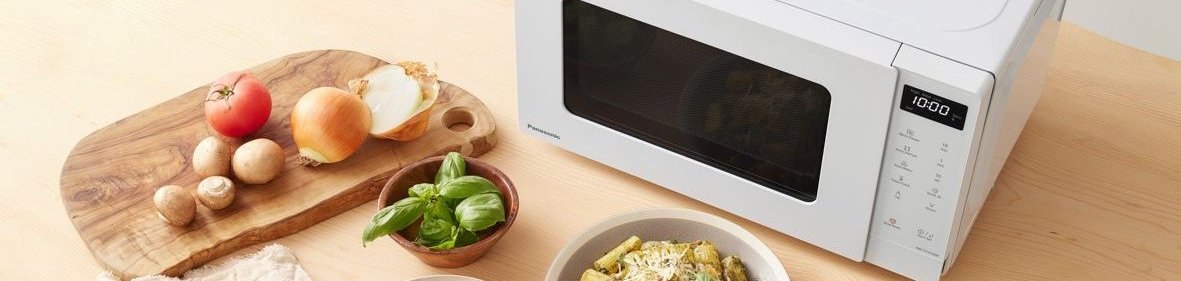
Some people may confuse inverter microwaves with convection microwaves. While both inverter microwaves and convection microwaves are different from your standard microwave oven, the two types of technologies couldn’t be further apart!
A convection microwave is a type of microwave oven that combines traditional microwave cooking with convection heating, similar to what you would find in an electric oven. This means that convection microwaves can be used to both heat food quickly (as a microwave) or to perform the typical functions of an oven, such as baking, roasting, broiling, and so on.
If you are choosing between an inverter microwave and a convection microwave, you should consider what type of cooking you are likely to be doing at home, since each type will be useful in very different situations. Inverter microwaves offer more precise temperature control, while convection microwaves provide more versatile cooking options.
Now that you’ve learned all about inverter microwaves, as well as the differences between them and other microwave models, what are you waiting for? Shop in-store or online at Noel Leeming today and find the right microwave for your kitchen.